On Oct. 20, a small crew of volunteers began unpacking crates in a staging area at Chicago’s McCormick Place. Inside are routers, switches, wireless access points, optical gear, and miles of fiber: about $62 million worth of hardware and software on loan from technology companies, research networks, and universities around the world.
Within a month, that equipment will become one of the most advanced networks on the planet, built by a team of 240 volunteers and existing for only a week. Helping lead this team is Debbie Fligor, Assistant Director of Networking with the Office of the CIO at the University of Illinois Urbana-Champaign.
The network they build is called SCinet, the high-capacity network built each year to support SC26, the annual international conference for high-performance computing, networking, storage, and analysis. As SCinet deputy chair for SC26, Fligor sits on the management team that oversees major network decisions and coordinates work across 18 technical teams.
Even as work on SC26 continues, planning is already underway for SC27, where Fligor will lead the effort as SCinet chair.
“We design the network for a year, build for a month, run it for a week, and tear it down in a day,” said Fligor, citing SCinet’s unofficial motto.
That year of planning reflects what the network has to do: SCinet is more than ordinary conference Wi-Fi. While it supports basic connectivity for attendees, it also gives exhibitors and researchers 400-gigabit connections for live experiments, some at speeds not yet commercially available. And each year, it grows. At SC25, SCinet delivered 13.72 terabits per second of bandwidth. For SC26, organizers expect more than 19 terabits per second, nearly 40% faster than the previous year’s speeds. That’s the combined speed of about 19,000 fast home internet connections.
And SCinet has come a long way since its first rendition in 1991, whose connection to the outside world ran at 245 megabits per second–roughly what a single household might have today. Thirty-five years later, the network will be more than 100,000 times faster.
But raw speed is only part of the story. SCinet also works as a temporary testbed for new tech. Contributors send their newest equipment and get to see how it holds up under heavy load alongside other companies’ gear. Volunteers get hands-on experience with technology that may not reach their own campuses for years.
The work on-site begins in October with staging. By the second week, at least 90 volunteers are unpacking, racking, and configuring equipment away from the show floor, which another event is using at the time. This year, the venue itself adds a challenge: McCormick Place is enormous and spread out, so volunteers have more ground to cover than at a typical convention center.
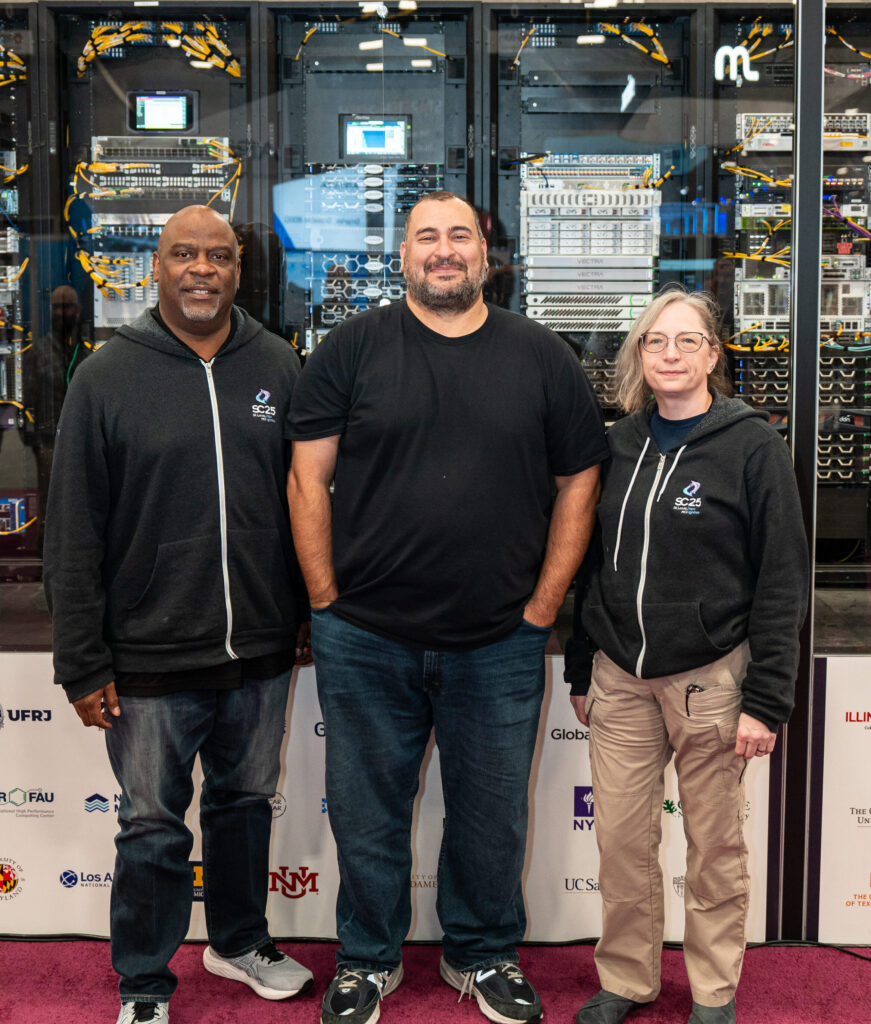
“The atmosphere [during the build-up] is usually intense, but fun,” Fligor said. “There is a lot to do and only a little time to do it in.”
In November, volunteers power everything down and move the loaded equipment racks to the exhibit hall. There, forklifts lift each rack onto a stage. Fligor calls that step “the most dangerous part of the event.” The exhibit hall must be live by noon on the Saturday before the conference, and that deadline can slip by only a few hours at most.
“When you build a network like this for a university data center, you’ll spend weeks on things SCinet crams into half a day,” Fligor said.
Pulling that off takes a lot of hands, none of which are paid. Each year, the build of SCinet is entirely volunteer-based. This year, 240 volunteers from eight countries, 28 states, and 109 organizations will build the network, with about 85% returning year after year. When asked what makes people want to return, Fligor said, “it’s getting to work with an entire group of like-minded people that like to do what you do, and do it well.”
That spirit of cooperation reaches beyond the volunteers. “At SC, vendors work together to make sure the network works,” Fligor said. “That’s something that you don’t always find elsewhere.”
Illinois is part of that effort, too. This year, the university is a platinum-level SCinet contributor—one of the program’s top tiers—recognized for the volunteers it provides from Technology Services and the National Center for Supercomputing Applications and for network connectivity through the Inter-Campus Communications Network. The university will receive an award for its contribution at SC26 on Nov. 16.
Since joining SCinet in 2015, Fligor has since led its Routing and Network Research Exhibition teams and served as its research director.
The experience she’s gained from this has come back to support the Illinois campus. Fligor worked with 100G Ethernet through SCinet years before Illinois had it, and she has firsthand experience with vendors the university was later considering. SCinet also prepared Fligor for leadership at Technology Services, the IT service arm of the Office of the CIO. “I was a team lead on SCinet for a 20-plus person team before I was a team lead in Technology Services,” she said. Fligor has also built a network of hundreds of networking professionals who help one another solve problems long after each conference ends.
When the show floor closes on the Thursday of conference week, volunteers begin taking the network apart. By Friday afternoon, the equipment is headed back to its contributors, and Fligor will turn to focus on SC27.
Learn more about SCinet at SC26 and the SC26 Conference.